The independence anniversary · A Beaches of Barbados data feature
Barbados at 60: tourist arrivals rise almost ninefold since independence
UK arrivals have grown 26-fold since 1966, according to a Beaches of Barbados analysis of historical records and revised official statistics. As the island approaches its 60th anniversary, the figures tell a story of changing visitors—and a coastline that matters to people and wildlife alike.
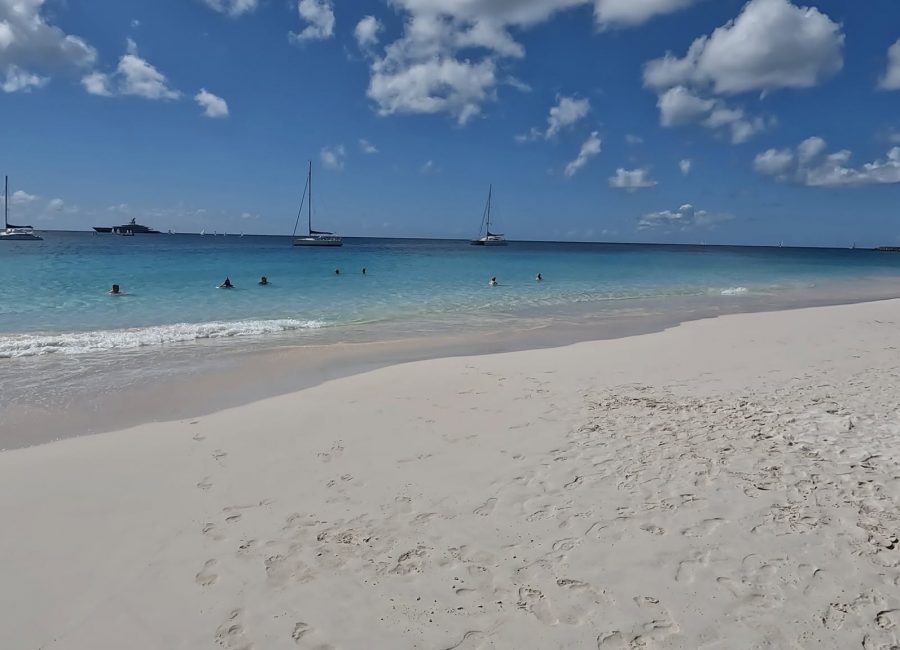
In the year Barbados became independent, it recorded 79,104 tourist arrivals. The latest complete-year official count is 707,046 stay-over arrivals in 2025: almost nine times as many, excluding cruise passengers in both cases. The figures come from an archived World Bank report reproducing Barbados’s historical statistics and the Barbados Statistical Service’s revised 2025 table. [1][2]
Within that growth sits a striking change in the island’s relationship with the UK. Arrivals from UK residents increased from 8,304 to 216,344, or 26.1 times their independence-year level. Yet the United States supplied more arrivals in 2025. This is a story about a changing visitor mix as well as a larger tourism industry.
A bigger destination—and a different visitor mix
The 60th anniversary on 30 November 2026 is an opportunity to look beyond the latest season’s performance. Rather than extrapolate an unfinished year, this comparison uses 1966 and 2025: a 59-year statistical interval within the anniversary story.
| Market | 1966 arrivals | 2025 arrivals, revised | Share: 1966 → 2025 |
|---|---|---|---|
| United Kingdom | 8,304 | 216,344 | 10.5% → 30.6% |
| United States | 23,827 | 241,571 | 30.1% → 34.2% |
| All other markets combined | 46,973 | 249,131 | 59.4% → 35.2% |
| Total | 79,104 | 707,046 | 100% → 100% |
The UK moved from roughly one in ten arrivals to almost one in three. The combined “other markets” category became smaller as a share, but grew substantially in absolute numbers. A falling share does not mean fewer visitors.
These are endpoints, not proof of a smooth upward trajectory. They cannot tell us which particular airline route, hotel opening or policy caused the change. Nor does “country of residence” establish a traveller’s nationality: someone living in Britain is counted in the UK market regardless of citizenship.
Barbados at 60: the story in numbers
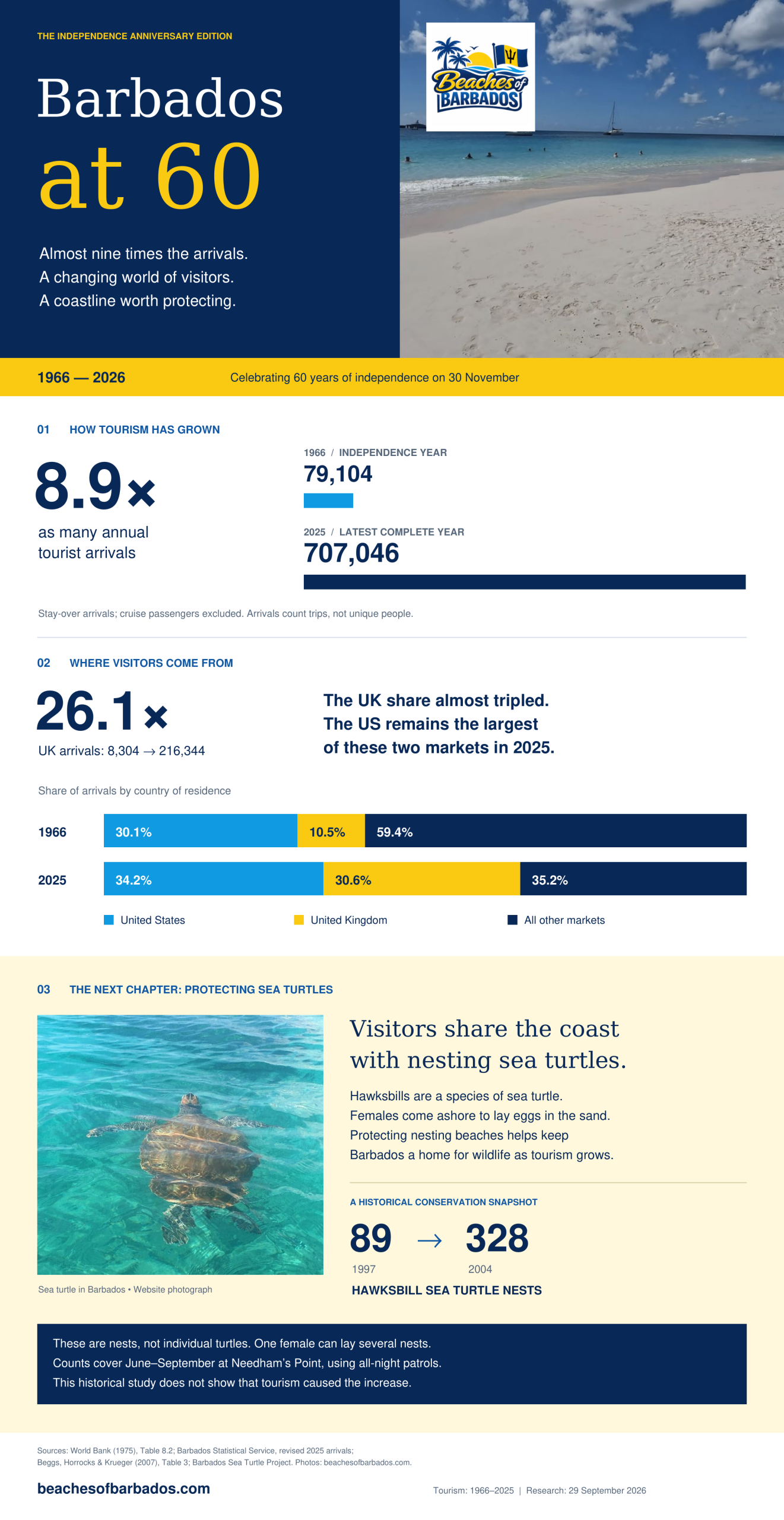
View the infographic at full size ↗
Research and design: Beaches of Barbados.
The nature connection: visitors and sea turtles share the coast
Hawksbills are a species of sea turtle. Females come ashore to lay eggs in nests dug into the sand. The connection to tourism is straightforward: beaches enjoyed by visitors also provide nesting habitat for sea turtles.
The Barbados Sea Turtle Project notes that nesting occurs on beaches with substantial tourism development. Its guidance identifies seawalls and buildings as threats to nesting space. As Barbados reflects on its tourism growth, protecting these beaches is a practical part of planning its next chapter. [3][5]
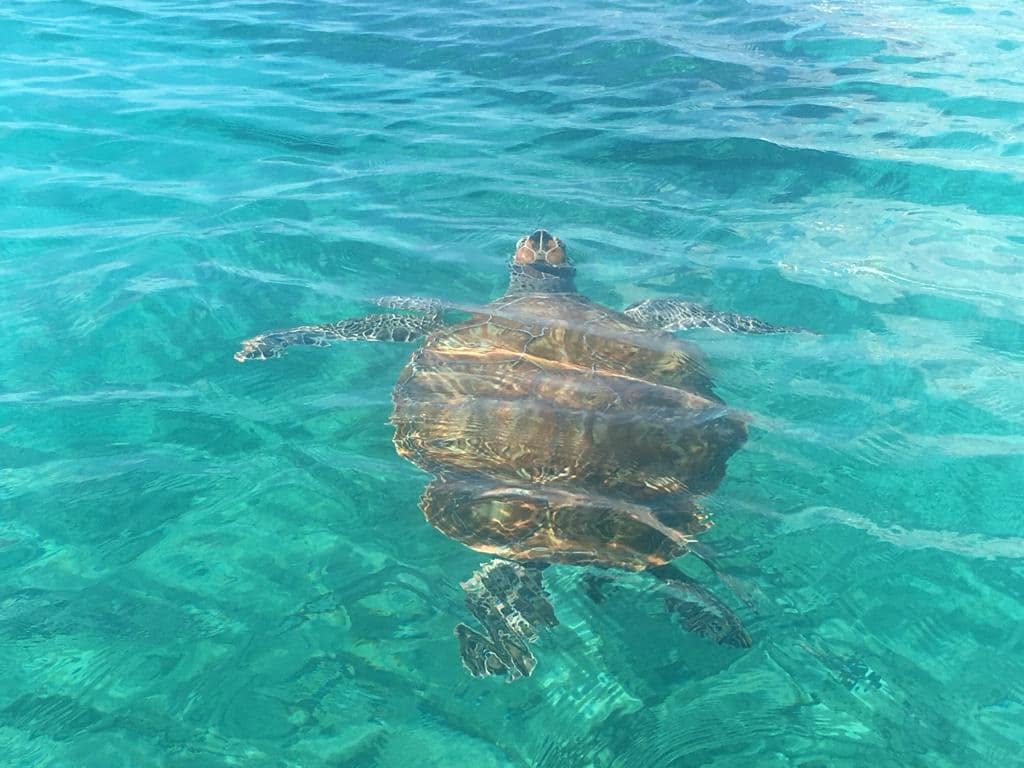
What the historical sea turtle study found
A peer-reviewed study by Beggs, Horrocks and Krueger recorded 89 hawksbill sea turtle nests in 1997 and 328 in 2004 at the Needham’s Point index beach during June–September. Both years used all-night patrols. That is a 3.7-fold increase in documented nests within that particular series. [4]
The researchers discussed reduced harvesting pressure, beach patrols and regional conservation measures as possible contributors. The earlier part of the study used a different monitoring method, which is why our comparison begins in 1997.
This is historical evidence of recovery, not a current island-wide population estimate. Nests are not individual turtles; one female can produce multiple nests. We have not located a verified 1966–2025 turtle series and do not present the tourism and nesting figures as correlated. The connection is their shared coastline: visitor numbers and nesting records describe different aspects of Barbados’s changing relationship with its beaches.
What the next 60 years could mean for the coast
For visitors, the practical response is to make wildlife care part of ordinary holiday planning. Ask accommodation providers how they manage lighting and beach furniture near nesting areas. Seek the turtle project’s current guidance before arranging a viewing experience, rather than treating a nesting animal as an attraction available on demand.
The project encourages hotel staff, visitors and beach users to report nesting, hatching and turtles in difficulty through its hotline. Its advice gives people visiting Barbados a way to contribute observations and seek help, without trying to handle wildlife themselves. [3]
For the tourism industry, this anniversary invites a broader definition of success. Arrival figures describe how much demand has grown. Protecting habitats, supporting local conservation expertise and making responsible choices easy for guests are questions about the quality of that growth. They deserve a place beside the visitor totals when considering the island’s next 60 years.
For practical advice on observing turtles responsibly, read our guide to snorkelling and sea turtles in Barbados . To explore the island’s coastline, use our Barbados beach finder .
Methodology and sources
Beaches of Barbados compiled this desk-based analysis from existing official statistics, an archived economic report and published conservation research. It is not a new visitor survey, wildlife census or causal study. The historical table calls its series “tourist arrivals”; the modern series is “stay-over tourist arrivals”. Cruise passengers are recorded separately and excluded here. Counts measure arrivals, not unique people. Statistical practices have evolved; these are published historical benchmarks rather than a retrospectively harmonised microdata series.
Growth multiples divide the 2025 count by the 1966 count. Market shares divide each market by that year’s total. “All other markets” is the residual after the UK and US, not a single origin region. Figures are rounded only for presentation.
- World Bank, Current Economic Position and Prospects of Barbados, Report 506a-BB, 21 July 1975 : Table 8.2, PDF page 218. The 1966 entries reproduce the Barbados Economic Survey 1972. The total, UK and US values were cross-checked against Table 1 on printed page 2/PDF page 8 of USDA Forest Service, Linking Conservation, Tourism and Sustainable Development in the Caribbean (2009) , which attributes its historical table to Barbados’s Ministry of Tourism and International Transport.
- Barbados Statistical Service, Stay Over Tourist Arrivals: Visitor Market by Month 2025 , revised table; annual and monthly figures.
- Barbados Sea Turtle Project, About Us : monitoring schedule, tourism setting and hotline guidance.
- Beggs, J.A., Horrocks, J.A. and Krueger, B.H. (2007), Increase in hawksbill sea turtle Eretmochelys imbricata nesting in Barbados, West Indies , Endangered Species Research 3:159–168, DOI 10.3354/esr003159. Table 3, printed page 164/PDF page 6, provides the comparable 1997 and 2004 seasonal index-beach observations.
- Barbados Sea Turtle Project, Protecting Sea Turtles FAQ : threats to nesting habitat.
About the author: Chris Clayton is the founder and editorial author of Beaches of Barbados. This feature presents his analysis of published sources; conservation findings are attributed to their researchers. No official endorsement or partnership is implied.
For editors: For editorial reproduction of the infographic, contact Beaches of Barbados to confirm image permissions and use the credit “Beaches of Barbados”. Please link to this feature so readers can review the sources and methodology. Research enquiries and corrections: chris@beachesofbarbados.com .