Wheelchair, mobility and inclusive beach planning
An accessible Barbados beach day is a chain—not a yes-or-no label
A ramp at the road is useful, but it does not answer what happens at the sand, toilet, lounger or shoreline. This guide helps you verify the complete journey from accommodation to beach and back.
The quick answer
There is no single “most accessible beach in Barbados” for every visitor. Accra Beach, serviced parts of Carlisle Bay and Miami Beach are useful places to investigate because parking or drop-off, food, public activity and facilities are comparatively close. The correct choice depends on your chair, transfers, walking tolerance, sensory needs, assistance and whether you want to reach the sand, sit beside the sea or enter the water.
Start with the whole journey
The seven links in an accessible beach day
A beach can work beautifully in one part of the chain and fail completely in another. Verify each link separately, ideally with measurements and current photographs rather than a general assurance that a venue is “wheelchair friendly”.
Useful wording: instead of asking “Is the beach accessible?”, ask “Please describe every surface, slope, step and distance between the vehicle, toilet, shade, sand and water.”
Beaches to investigate
Accessible Barbados beach starting points compared
These are planning leads, not accessibility certifications. Access points, vendors, temporary obstructions and equipment availability can change. Contact the beach facility, hotel, support provider or driver with your exact requirements before setting off.
| Location | Why investigate it | Firm-surface experience | Sand and sea access | Facilities nearby | What to verify |
|---|---|---|---|---|---|
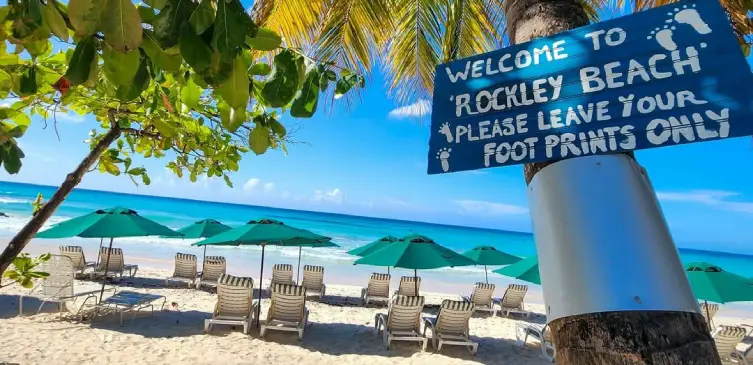
| Accra Beach / Rockley | Strong starting pointSouth coast | Parking, road access, shops and the wider pedestrian area are close. The Richard Haynes Boardwalk provides a coastal outing without requiring a sand crossing. | The public area reaches sand; ordinary wheelchair performance on soft sand will be limited without specialist equipment. | Official destination information lists basic beach facilities, lifeguard coverage, nearby restaurants, vendors and parking. | Verify exact drop-off, kerbs, toilet layout, path width, sand transition and whether the boardwalk route suits your device. |
| Pebbles / Carlisle Bay | Beach-chair potentialCalmer bay | Roadside access and serviced properties sit relatively close to sections of the bay. | The FAB amphibious wheelchair has been used at Pebbles, but it must be arranged and operated safely. Water conditions still decide whether sea entry is sensible. | Food, shade, hotels and activity providers vary by the exact section chosen. | Verify chair availability, responsible companion, life jacket, transfer method, boat traffic, water entry and accessible toilet access. |
| Miami Beach / Enterprise | Public facilityShade and picnic space | Vehicle access, public activity and shaded areas make it easier to investigate than a hidden access lane. | The western cove may be more sheltered in suitable conditions, but the final sand route and transfer into water require direct checking. | Public facilities, food and lifeguard coverage are commonly associated with the beach. | Verify step-free route, toilet door and turning space, seating height, sand depth and the distance from shade to water. |
| Richard Haynes Boardwalk | Coast without sandFood nearby | A firm coastal route links parts of Hastings and the south coast, with restaurants and sea views. | This is primarily a promenade experience. Small beach openings along the route do not necessarily provide accessible sea entry. | Restaurants and hotel facilities are nearby, but access and toilet use may depend on the business. | Verify the best ramp or entry point, gradients, route interruptions, seating and accessible toilets at a specific venue. |
| Serviced hotel beach | Staff supportDay-room potential | A hotel may offer lifts, level internal routes, accessible rooms or changing space that a public beach cannot. | A ramp to a deck does not guarantee a route across sand or into the sea. Beach-wheelchair or transfer support must be confirmed separately. | Food, shade, toilets and indoor cooling are more likely to be close together. | Verify day-pass availability, room use, hoists, staff assistance limits, beach route, shower access and emergency plan. |
Why we do not publish a definitive ranking: an independent power-chair user, a manual-chair user with a strong companion, a person walking short distances with sticks and someone needing a hoist may reach completely different conclusions about the same beach.
Best first enquiry
Accra Beach and the Rockley area
Accra Beach is the most useful first place to investigate because the beach, parking, public transport, food, shops and the south-coast pedestrian environment are concentrated into a relatively small area. Official destination information lists parking, basic beach facilities and lifeguard coverage, while the nearby Richard Haynes Boardwalk offers a firm-surface way to experience the coast.
That does not make the sand accessible by default. The exact transition from road or promenade to beach matters, and deep sand can stop a standard manual or power wheelchair almost immediately.
- Ask for the precise drop-off point rather than requesting “Accra Beach”.
- Request current photographs of the route to the toilet and sand.
- Confirm whether shade seating has arms and enough space for a side transfer.
- Use the boardwalk as the backup plan when heat, sand or sea conditions make beach access unsuitable.
Our honest view: Accra’s advantage is not a magical ramp into the sea. It is the number of practical options within a small area when one part of the day proves inaccessible.
Beach-wheelchair planning
Pebbles and Carlisle Bay with FAB support
The Barbados Council for the Disabled operates the Fully Accessible Barbados programme and provides an amphibious beach wheelchair by prior arrangement. The chair is designed to cross sand and enter calm water, and the Council has documented its use at Pebbles Beach on Carlisle Bay.
The chair does not make sea entry automatic. The Council states that it must be operated by a responsible companion, that safety precautions must be followed, that the user should not be attached to the chair and that a life jacket should be worn.
- Book in advance and confirm delivery, collection, cost and cancellation arrangements.
- Discuss body support and transfers honestly. Ask what the chair does and does not provide.
- Name the responsible companion and make sure they can manage the equipment.
- Use calm, suitable water only and follow lifeguard, Council and local safety advice.
- Plan privacy and personal care before and after entering the sea.
Do not improvise a transfer into surf. Fatigue, heat, waves, wet sand and an unfamiliar chair can turn a routine transfer into a high-risk one very quickly.
Access is broader than mobility
Planning for different access requirements
Wheelchairs and mobility equipment
- Confirm surface, width, gradient and kerbs for the entire route.
- Ask whether a power chair can be stored safely near salt spray and sand.
- Carry charging information, tools and essential spares.
- Check chair weight and dimensions against vehicle lifts and ramps.
- Never allow untrained helpers to lift a person or chair unexpectedly.
Visual or hearing access
- Ask for spoken orientation to the water, facilities, steps and boat areas.
- Agree clear tactile or verbal meeting points.
- Do not rely on flags or visual warnings alone; speak to a lifeguard.
- For hearing access, ask how warnings will be communicated.
- Keep a phone or communication method protected from water and glare.
Sensory, cognitive and hidden disabilities
- Visit early for lower heat, noise and crowd levels.
- Identify a quiet, shaded retreat and a simple exit route.
- Prepare for whistles, music, vendors, engines and unpredictable waves.
- Use a visual plan or short sequence for arrival, changing and leaving.
- Tell companions what distress, fatigue or overload looks like for you.
Fatigue, pain and limited walking
- Ask for distance in metres, not “a short walk”.
- Confirm resting places and whether seating has a back and arms.
- Keep the beach visit shorter than the maximum possible duration.
- Plan for the return when heat and wet clothing increase effort.
- Arrange pickup before symptoms worsen.
Heat sensitivity and medical needs
- Verify reliable shade and indoor cooling nearby.
- Carry water, medication and any written emergency plan.
- Protect medication from heat according to professional advice.
- Know the closest suitable toilet and medical facility.
- Leave early when heat or symptoms begin to build.
Companions and personal assistants
- Agree which tasks require trained assistance.
- Do not assume hotel, beach or taxi staff can provide personal care.
- Plan breaks for the companion as well as the disabled traveller.
- Keep transfers consensual, dignified and unhurried.
- Have a plan for equipment failure or an unwell companion.
Ask questions that produce useful answers
A message you can send to a hotel, beach club or transport provider
Copy, personalise and send this before booking. Ask the recipient to answer each point rather than replying only that the property is accessible.
Red flag: if a provider repeatedly answers “yes, accessible” without describing surfaces, measurements or assistance, you still do not have enough information to plan the day.
Accessible transport
The beach is only useful if the journey works
Book a suitable vehicle directly
The Barbados Council for the Disabled says it provides accessible transportation, while official tourism information lists providers offering specialist transport for wheelchair users. Describe the passenger, chair, transfer method and luggage rather than merely requesting a “wheelchair taxi”.
Give the exact access point
A driver may know the beach but not the ramp, hotel entrance or boardwalk access you have verified. Save the pin, business name, photograph and phone number of the person meeting you.
Protect the return
Agree a pickup time and a location reachable even if sand, rain or crowding changes the route. Carry the driver’s number and have a backup contact rather than relying on finding an adapted vehicle spontaneously.
Current official listing: Blessed Rentals is listed by Barbados Tourism as offering special transportation for wheelchair users. Its published telephone number is +1 246 243 1894. Confirm current vehicle specifications and availability directly.
Sea access is a separate decision
Before using a beach wheelchair in the water
Equipment
- Confirm the chair is designed for water, not only sand.
- Ask about head, trunk and lateral support.
- Check the chair’s user limits and transfer requirements.
- Use the required life jacket and safety equipment.
- Know who inspects, cleans and maintains the chair.
People
- Identify the responsible companion or trained operator.
- Discuss consent and communication before entering.
- Never secure a person in a way that prevents a safe response.
- Have enough helpers for the chair and transfer method.
- Agree the signal for stopping and returning to shore.
Conditions
- Use calm water only and follow current local guidance.
- Avoid shore break, strong current and busy boat channels.
- Assess the return route as the tide and sand change.
- Keep the first session short.
- Stop immediately if the user or helpers become tired or uncomfortable.
This guide cannot assess whether water access is medically or physically suitable for an individual. Discuss personal transfer, posture, breathing, skin, seizure, temperature-regulation or other clinical risks with an appropriate professional before travelling.
A realistic half-day
Example accessible beach-day structure
This structure deliberately leaves space. Accessibility works better when the schedule absorbs delays rather than punishing everyone for them.
Local organisations and services
Contacts worth saving before the trip
Barbados Council for the Disabled
Accessible transport, beach wheelchairs, sign-language interpreters and other support for residents and visitors.
Telephone: +1 246 629 0574
Fully Accessible Barbados
The Council’s accessibility programme, including information about the amphibious FAB beach wheelchair.
Official tourism listing: telephone +1 246 629 0570; WhatsApp +1 246 233 6899.
Wheelchair transport listing
Blessed Rentals is listed by Barbados Tourism as offering specialist transportation for wheelchair users.
Telephone: +1 246 243 1894
Beach safety and alternatives
Check the sea before committing to water entry and keep a firm-surface alternative ready.
A beach day can still work without the beach
Accessible backup plans near the coast
Boardwalk and lunch
Use the Richard Haynes Boardwalk for sea views and choose a restaurant whose entrance and toilet you have verified. This keeps the coast in the day without requiring a sand or water transfer.
Hotel day room or pool
A day room can provide an accessible toilet, changing space, air conditioning and predictable seating. Confirm pool access and hoists separately; an accessible room does not prove the pool or beach route works.
Scenic coastal drive
Bathsheba, the east coast and northern viewpoints can be enjoyed from selected roadside stops with a suitable driver. Ask where the vehicle can stop safely and which viewpoints avoid steps, rough ground or cliff edges.
A backup is not second best. A relaxed boardwalk lunch can be a better shared experience than forcing a sand transfer because the holiday plan says “beach day”.
Questions accessible travellers ask
Accessible Barbados beach FAQs
Are there wheelchair-accessible beaches in Barbados?
Some Barbados beach areas are easier to investigate because parking, firm routes and facilities are nearby, but accessibility differs by person and by the exact access point. Accra, serviced sections of Carlisle Bay and Miami Beach are useful starting points for direct enquiries rather than guaranteed solutions.
Where can I hire a beach wheelchair in Barbados?
The Barbados Council for the Disabled’s Fully Accessible Barbados programme provides an amphibious beach wheelchair by prior arrangement. Contact the Council before travelling to confirm availability, cost, delivery, companion requirements and safety arrangements.
What is the Barbados Council for the Disabled telephone number?
The Council currently publishes +1 246 629 0574. Official tourism information also lists Fully Accessible Barbados on +1 246 629 0570 and WhatsApp +1 246 233 6899. Confirm the current contact when booking.
Can a normal wheelchair travel across beach sand?
Most standard manual and power wheelchairs perform poorly in deep, soft sand and may become stuck or damaged. Use a firm path, beach mat or specialist sand or amphibious wheelchair that is appropriate for the user and operated according to its instructions.
Can the FAB beach wheelchair enter the sea?
The Council describes the FAB chair as amphibious and suitable for a leisurely soak in calm water. It must be operated by a responsible companion, the user should not be attached to it and a life jacket should be worn. Current sea conditions and individual suitability still matter.
Is Accra Beach wheelchair accessible?
Accra is a useful place to investigate because parking, facilities, restaurants and the nearby boardwalk are close. The final route across sand and into water is a separate issue. Ask for current measurements, photographs and the exact drop-off point before relying on it.
Is the Richard Haynes Boardwalk wheelchair accessible?
The boardwalk offers a firm coastal route and is a promising option for many mobility-device users, but access points, gradients, route interruptions and nearby toilets should be verified for the individual device and support needs.
Is accessible wheelchair transport available in Barbados?
The Barbados Council for the Disabled says it provides accessible transportation. Barbados Tourism also lists Blessed Rentals as offering special transportation for wheelchair users. Book in advance and provide the chair dimensions, weight, transfer method and luggage requirements.
What should I ask an accessible hotel or beach club?
Ask for distances, gradients, widths, steps, surfaces, toilet layout, transfer space, shade, seating, changing arrangements, beach-wheelchair availability and current photographs of the entire route from vehicle to water.
Which Barbados beach is best for someone who cannot cross sand?
The best plan may be a coastal boardwalk, serviced deck or restaurant rather than a conventional beach visit. Accra and the Richard Haynes Boardwalk provide a useful area to investigate because the coast can be experienced from firm surfaces with facilities nearby.
How this guide was checked
This guide expands the original Beaches of Barbados planning advice with current information from the Barbados Council for the Disabled and Barbados Tourism Marketing Inc. It avoids describing a beach as universally accessible and separates vehicle access, firm-surface access, sand access and water access.
Fully Accessible Barbados beach wheelchair · Barbados Council for the Disabled · Official Fully Accessible Barbados listing · Official accessibility-services directory · Official wheelchair-transport listing
Editorial review: 5 August 2026. Equipment, contacts, access routes, facilities and assistance can change. Verify the exact arrangements directly before travelling.
Verify the route before committing
Keep two suitable coastal plans ready
Use the beach map to compare locations, then contact providers with the enquiry template above. A firm-surface boardwalk or accessible lunch venue makes a strong backup when sand, heat or sea conditions do not cooperate.